
How We Stopped Knowing Things for Ourselves
Why “Grok, is this true?” is the wrong question

We’re only three days into 2026, but I’ve had multiple conversations with close friends who’ve confided that this year they plan to do what Dr. Timothy Leary suggested back in 1966.
Turn on, tune in, drop out.
Many believe that Dr. Timothy Leary was connected to the CIA, although the official story is that he wasn’t.
Official story. Did I just write that?
Irony aside, the statement still sounds charming. However, removing that programming from earshot and eyeshot only works in theory.
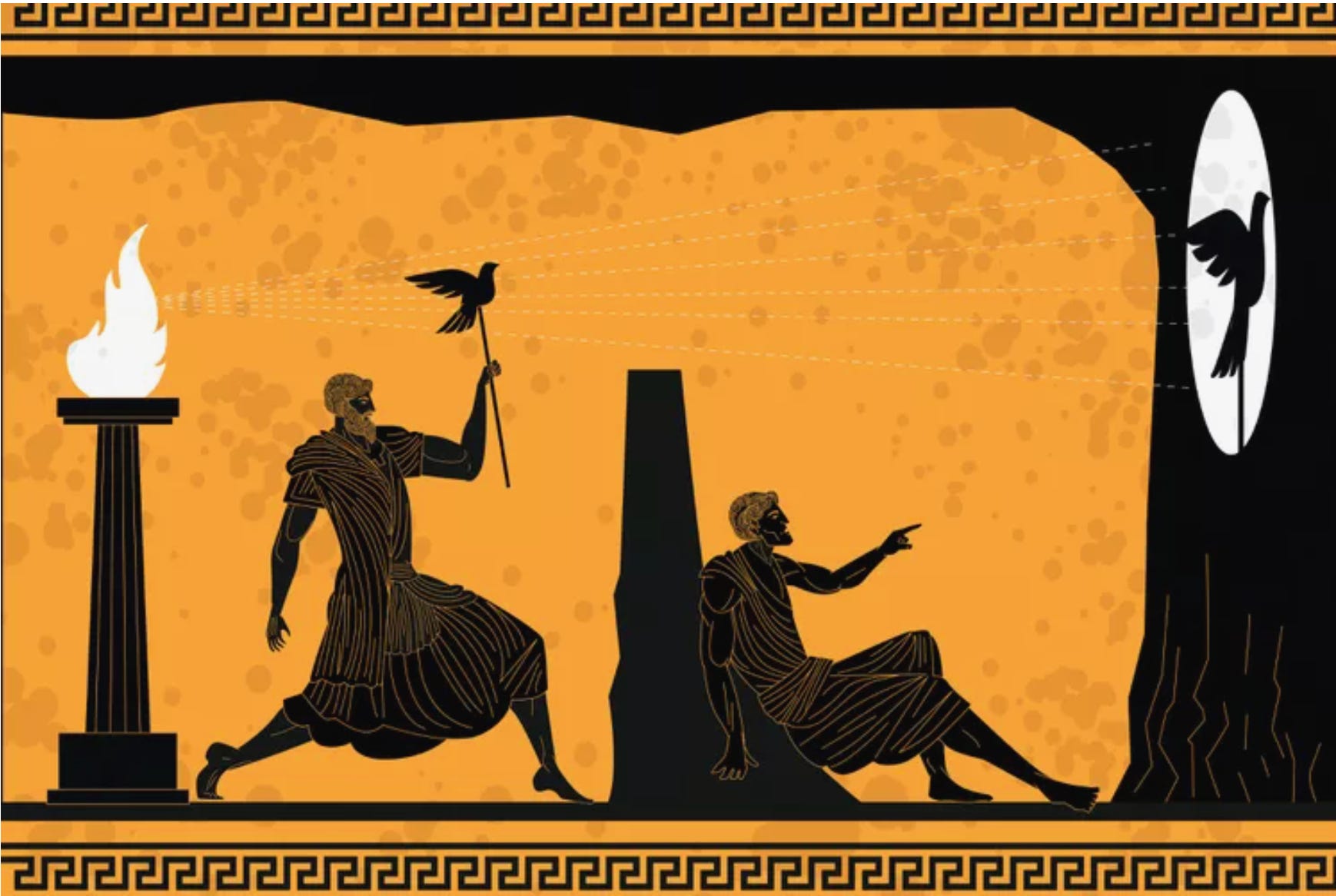
The problem is multi-pronged. But there is a through-line. And if you are looking for the tl;dr it’s this: What all of this has in common is epistemic outsourcing—the quiet, incremental surrender of our responsibility to know things for ourselves.
Many institutions exist for the sole reason of programming us.
Schools call it “education.” They even gamify it, starting with gold stars in primary education, moving to AP in high school and then later assigning letters to each level—MFA in college and then in post-grad, PhD, DPhil, etc. This education is also state-sponsored: Sesame Street and the like.
But how much truth is taught as opposed to “truth”? Or, more importantly, why did we stop teaching people how to think critically?
Legacy media calls it “news,” although most of what passes for news today is opinion.
I initially majored in journalism at Ithaca College before I realized the teacher’s directive to “remain objective” was not what I was witnessing in journalism with my own eyes or from my own research.
For instance:
CNN breached ethical standards during the Saddam Hussein regime by suppressing reports of torture and murder in order to keep their Iraq bureau open.
Walter Duranty got a Pulitzer for lying about the widespread famine in the Soviet Union.
Bob Woodward’s book on John Belushi’s life, which was presented as only reported facts, was considered flawed even when it came out in 1984.
That doesn’t even take into account that legacy media has been manipulated by the CIA (and no doubt other agencies and individuals) knowingly or unknowingly for decades. Operation Mockingbird was very real—and, for all we know, may still be influencing podcasters today.
Pop culture also has a narrative that needs to be controlled.
How many movies will be subsidized by governments (our own or otherwise) to shape perception? In addition to studying journalism, I also minored in Russian History. The Soviets set the precedent when it came to censorship regarding movies, music and art, although they weren’t the only country to do so. Britain wanted Stanley Kubrick to edit A Clockwork Orange to avoid censorship. He refused, and the film got banned.
Hollywood’s Motion Picture Association of America assigned it an X, which limited the audience.
This isn’t old news. In recent years, Europe and America have been trying to crack down on what they call “misinformation,” which is often subjective and always a means to control the approved narrative.
In America, Nina Jankowicz, who sang Mary Poppins-like songs about “disinformation” might have been the country’s face of control were it not for people mocking her.
AI is the next form of control.
It’s not a coincidence that generative AI is being foisted upon us in every facet of our online lives—whether we want it or not. Firefox, which used to stand for privacy, received massive backlash after its CEO gushed about turning Firefox into a modern AI browser that no one asked for or wanted.
And now, people are using GPT and X to “verify” stories and posts. While some of it is online humor, the phrase “Grok, is this true” is being used with such alarming regularity it should give one pause. Outsourcing your knowledge to AI is not only dangerous, it’s stupid.
“Truth” is in the eye of the programmer who chooses what sources to scrape. While Wikipedia is obviously biased, people have been complaining about that for years.
Will Elon Musk’s “Grokipedia” fix this? Doubtful.
Part of it is that everything that has been written, filmed, recorded and made, has some bias in it. Some of it is deliberate, some is unconscious.
We no longer have a shared experience, but a lived experience.
It’s a new form of narcissism we’re supposed to applaud. Where were you when you first heard the phrase, “my truth”? This assumes that truth isn’t absolute, which is a deliberate effort to divide us. Because it’s impossible to relate to someone who has their own “lived experience,” that no one else can understand.
There’s no reason to believe this isn’t deliberate.
History taught us, we can’t trust history.
The media is at odds with the truth.
Pop culture shapes perception but doesn’t get us any closer to understanding.
Language is being shaped to divide us, not unite us.
And gatekeepers want to silence dissenting opinions or what they call “disinformation,” as a way of removing what’s left of our ability to think critically about anything.
This doesn’t mean everything is fake or everyone is conspiring to hide reality from you. What it does mean is that you have to read multiple sources, not just your preferred ones, and have enough discernment to see the nuances and parse the differences.
So what’s the answer?
Stop epistemic outsourcing.
If you’re letting everyone—and everything—do your thinking for you, make 2026 the year you change that behavior.
It’s impossible to remove yourself completely, unless you live in a hovel.
Unless you are a Trappist Monk or religious equivalent, or a hermit, the idea of living free from all of this is impossible. The only thing you can do is recognize when a narrative is being shaped, and look at as many different versions of the same picture as possible. And for the love of all that is true, start making up your own mind.
If you made it this far, thank you. I hope you will support me by becoming a free or paid subscriber.
And if you’re like “hey thanks but I’d rather read fiction,” good news: I have a new Substack called Match Fiction which is flash fiction inspired by my vintage match collection. There are 150 matchbooks, and I am writing a story based on all of them. I’m still early in the process.